
English 

Views: 0 Author: Site Editor Publish Time: 2026-08-08 Origin: Site


Disorganized kitchens and chaotic food storage systems lead to wasted space, premature food spoilage, and daily frustration when matching containers to lids. Mismatched container shapes and legacy plastic sets create inefficient footprints, resulting in dead zones on shelves and compromised meal prep workflows. You end up shoving items to the back of the fridge, where they freeze or rot out of sight. Buyers need a storage system that maximizes capacity without sacrificing durability or food safety. Standardizing your storage ecosystem around specific geometric shapes—particularly utilizing stackable glass food containers—solves spatial inefficiency, enhances thermal versatility, and provides a scalable, long-term organization strategy. Moving away from random plastic tubs to a calculated, geometry-based approach reclaims lost shelf real estate. It streamlines your daily cooking routine and ensures ingredients remain visible, accessible, and properly preserved.
Spatial Efficiency: Square and rectangular footprints maximize shelf capacity by eliminating the dead space inherent to round containers, making them ideal for both bulk goods and daily leftovers.
Material Superiority: Stackable glass food containers offer unmatched thermal stability, hygiene, and long-term durability compared to degrading plastics.
Workflow Optimization: Purpose-built meal prep glass containers streamline portioning and transition seamlessly from freezer to oven to table.
Advanced Preservation: Integrating specialized solutions like two color vacuum containers provides verifiable airtight seals, significantly extending the shelf life of sensitive ingredients.
Mathematical spatial efficiency dictates exactly how much food your kitchen can hold. Standard upper kitchen cabinets measure 12 inches deep, while base cabinets and refrigerators range from 24 to 36 inches deep. Flush edges and 90-degree angles utilize 100% of this available shelf depth and width. Cylindrical shapes create tangent-point gaps. When you place round items side by side, empty triangles form between them. This geometry wastes valuable real estate. Square and rectangular shapes lock together seamlessly, turning your fridge shelves into a high-density storage grid.
Consider the math on a standard 12-inch by 12-inch shelf footprint. This area holds exactly four 6-inch square containers, utilizing all 144 square inches of available space. If you use four 6-inch round containers in that same space, you only utilize about 113 square inches. You instantly lose over 21% of your shelf capacity to empty air. This lost space forces you to stack items haphazardly, leading to cluttered shelves and forgotten leftovers pushed to the back.
Rectangular containers fit deep pantry shelves perfectly. They hold bulk dry goods, large casseroles, and elongated produce like carrots and celery. Their wide front profile maximizes the forward-facing label area, helping you identify fresh food categories instantly. You can pull a rectangular container out like a drawer, granting easy access to the back of the fridge. Square containers offer a different balance. They work best for modular fridge stacking and everyday leftovers. Square footprints optimize shallower cabinet spaces and fit perfectly into corners where rectangular containers might protrude.
Flat, clear sides provide superior surface area for inventory labeling. Curved walls distort the view of the contents inside, bending light and making it difficult to gauge remaining quantities. Flat glass offers distortion-free visibility. You can assess your inventory at a single glance without pulling the container off the shelf.
Container Geometry Efficiency Comparison
Shape Profile | Space Utilization | Best Food Types | Cabinet Fit |
|---|---|---|---|
Rectangular | Excellent (95-100%) | Casseroles, long vegetables, bulk grains | Deep shelves, narrow pull-outs |
Square | Excellent (95-100%) | Diced ingredients, leftovers, berries | Shallow shelves, tight corners |
Round | Poor (70-75%) | Soups, broths, sauces | Center shelf placement only |
The dead space penalty is an unavoidable physical reality. You lose up to a quarter of your shelf space when utilizing round footprints in square cabinets. Rectangular refrigerators punish round containers similarly. The curved edges push other items away and disrupt the linear flow of your storage ecosystem. However, round shapes serve specific functional purposes that justify their spatial inefficiency in certain scenarios.
Liquid storage demands round vessels. Soups, broths, and sauces flow naturally along curved walls. A round interior eliminates tight 90-degree corners where thick liquids get trapped and congeal. You can scrape a round bowl clean with a silicone spatula effortlessly, minimizing food waste.
Round containers also promote even heat distribution during microwave reheating. Microwaves create standing waves that bounce around the interior of the appliance. They concentrate energy in the corners of square containers. This causes the edges of your food to boil and overcook while the center remains frozen. Round containers lack corners, allowing convection currents to circulate the food evenly. The microwave energy distributes across the entire volume of the food. Stirring contents inside a round container feels natural because the spoon glides along the continuous curve. Reserve round containers strictly for liquid-heavy applications. Keep them out of your dry pantry and use them selectively in your refrigerator to minimize the dead space penalty.
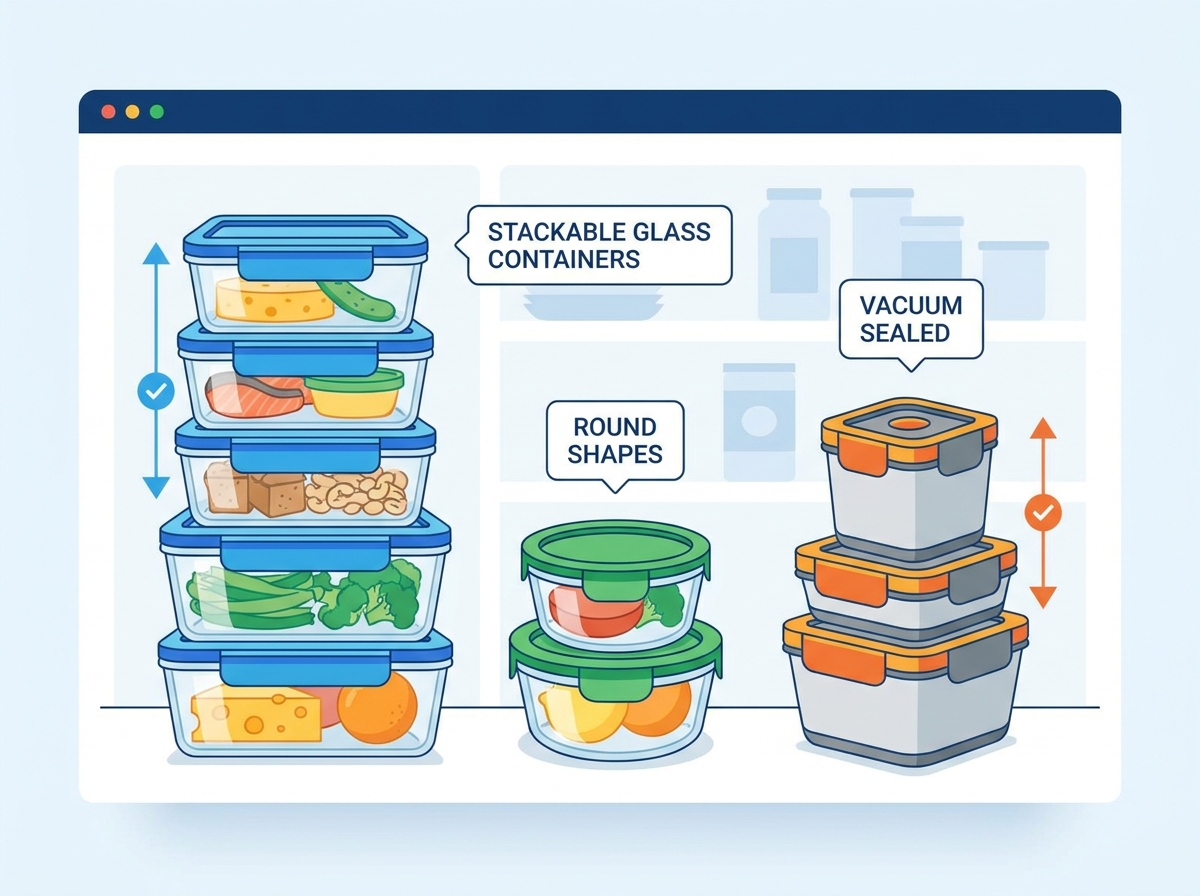
Vertical scalability requires specific engineering. Safe stacking relies on recessed lid bases. A flat lid allows the container above to slide off easily when you bump the shelf. A recessed lid creates a physical lip that locks the base of the top container into place. Interlocking capabilities prevent lateral shifting when you open and close fridge doors rapidly. Anti-slip silicone bumpers add friction and absorb minor impacts during daily handling.
You must consider weight and load limits when building a vertical storage system. Glass carries significant mass. A stack of four large glass containers filled with dense food can weigh over 15 pounds. Evaluate the load-bearing limits of your fridge shelves. Tempered glass refrigerator shelves typically hold between 35 and 50 pounds safely. Stacking heavy borosilicate glass vertically concentrates this weight into a small footprint. Distribute heavy items near the shelf supports or brackets. Do not place massive glass towers in the unsupported center of a wide glass fridge shelf, as this causes bowing and potential failure.
Empty storage demands a strategic approach to reclaim cabinet space. Sort empty containers by shape and nest them from largest to smallest. This drastically minimizes the cabinet footprint. Active use requires space, but idle containers should disappear. Remove the lids before nesting. Stack the glass bases inside one another. Place a small paper towel or a dedicated felt separator between nested glass bases. This prevents them from binding together due to moisture or vacuum pressure. It also stops edge chipping caused by glass-on-glass contact.
Modularity matters immensely when building a long-term system. Buy into a standardized ecosystem where multiple smaller containers share the exact footprint of a single large container. For example, two small rectangular containers should sit perfectly on top of one large rectangular container. This ensures interlocking stability across your entire collection. It transforms a random assortment of bowls into a cohesive storage system. Investing in Stackable Glass Food Containers guarantees this modularity, allowing you to scale your storage capacity predictably.
Borosilicate glass offers exceptional thermal shock resistance. It contains boron trioxide, which gives it a very low coefficient of thermal expansion. It moves directly from freezing temperatures to high-heat ovens without shattering. Standard soda-lime glass expands rapidly when heated, causing catastrophic failure and dangerous shattering. Borosilicate handles extreme temperature swings safely, making it the superior choice for freezer-to-oven meal prep.
Legacy plastics melt, warp, or blister under similar thermal stress. Plastic containers degrade in the microwave, often leaching microplastics and chemical plasticizers into your food. Glass maintains strict hygiene. Its non-porous nature prevents stain absorption. Tomato sauce ruins plastic permanently by leaving an orange haze of porphyrins that never washes out. Tomato sauce washes right off glass with warm water.
Glass rejects residual odors completely. Garlic, onions, and strong curries leave lasting smells in plastic containers, ruining the flavor of whatever you store next. Glass rinses clean and smells like nothing. When evaluating containers for months or years of continuous use, focus on the resilience of the glass edges. Look for rolled or reinforced rims that resist chipping during daily handling. Examine the hinge fatigue resistance of the locking lids. Plastic snap hinges bend and flex, eventually snapping off after a few hundred uses. High-quality lids use reinforced silicone hinges or thick polycarbonate clips that endure thousands of open-and-close cycles.
Material Performance Breakdown
Material Type | Thermal Shock Resistance | Stain & Odor Resistance | Lifespan |
|---|---|---|---|
Borosilicate Glass | Excellent (Freezer to Oven) | Complete Resistance | Decades |
Soda-Lime Glass | Poor (Prone to shattering) | Complete Resistance | Years (if handled carefully) |
Polypropylene Plastic | Poor (Warps in microwave) | Fails quickly (Absorbs stains) | Months to a few years |
Built-in glass dividers enable strict portion control and separate wet and dry ingredients during weekly meal prep. You can store grilled chicken in one compartment and fresh spinach in another. The juices will not mix, ensuring the spinach stays crisp until lunchtime. Purpose-built meal prep glass containers act as essential workflow tools. They reduce transfer steps significantly. You prep, store, reheat, and eat from a single vessel, which eliminates extra dirty dishes and cuts cleanup time in half.
Batch cooking becomes highly efficient with compartmentalized glass. You cook large quantities of food on Sunday and portion them directly into the containers. These containers streamline your morning routine. You grab a pre-portioned meal from the fridge and leave for work without thinking. The secure locking lids prevent leaks in your bag during transit. The glass base reheats safely in the office microwave, meaning you do not need to transfer the food to a ceramic plate.
Compartmentalization helps maintain strict dietary goals by providing visual cues for macronutrient balance. Half the container holds vegetables, a quarter holds lean protein, and a quarter holds complex carbohydrates. The physical dividers enforce these ratios automatically, removing the guesswork from daily nutrition and preventing overeating.
Rigid glass containers support heavy vacuum sealing, which mitigates oxidation. Oxygen degrades vitamins, breaks down fats, and causes enzymatic browning in apples and avocados. Removing the ambient air halts this process entirely. It prevents freezer burn by eliminating the moisture-laden air that forms ice crystals on the surface of your food. It also slows bacterial growth significantly. Aerobic bacteria require oxygen to multiply, and vacuum sealing starves them of this essential element.
Modern two color vacuum containers feature advanced visual verification systems. Two-color indicator valves function as a brilliant mechanical fail-safe. You attach a small handheld pump to the valve and extract the air. As the internal pressure drops, the silicone diaphragm pulls downward, depressing the valve. It reveals a second color, usually green, providing immediate visual confirmation that the vacuum seal remains intact.
If the seal fails due to a dirty gasket or a temperature shift, ambient air rushes back in. The valve pops up, and the original color returns. You never have to guess if your food is protected. You can scan your fridge and verify the seal on every container instantly. This technology extends the shelf life of sensitive ingredients by weeks. It protects expensive items like fresh berries, artisan cheeses, and premium coffee beans, drastically reducing household food waste.
You must mitigate the lid avalanche to maintain an efficient kitchen. Storing lids loosely in a drawer leads to chaos, forcing you to spend minutes digging for the right match while your hot food waits. Use vertical filing systems to solve this. Bamboo pot lid organizers work perfectly for container lids. Alternatively, install short spring-loaded tension rods inside a deep drawer to create custom dividers. Space the rods two inches apart and store lids vertically by size and shape.
Keep all square lids in one channel and all rectangular lids in another. This mimics a filing cabinet. You can slide the exact lid you need out instantly without disturbing the others. Storing lids vertically also prevents them from warping under the heavy weight of glass bases stacked on top of them.
Prioritize brands that utilize universal lid sizing. Varying container depths should share the exact same lid footprint. A shallow 2-cup rectangular container and a deep 6-cup rectangular container must use the exact same lid. This reduces sorting time drastically because you only need to match the shape, not the depth. It cuts your required lid inventory in half. When buying a new set, verify this interchangeability. Discard any orphaned lids immediately. If a glass base breaks, throw away the matching lid unless it fits other containers in your ecosystem. Clutter breeds inefficiency.
Dishwasher loading protocols matter when handling glass. Space glass containers properly on the racks and never let them touch each other. The high-pressure water jets cause items to vibrate violently during the wash cycle. If glass containers touch, this vibration causes micro-abrasions. Over time, these microscopic abrasions weaken the structural integrity of the glass, leading to edge chipping and eventual shattering. Place glass bases securely over the tines to ensure they cannot rattle.
Wash lids on the top rack only. The heating element at the bottom of the dishwasher reaches extreme temperatures that can warp plastic lid frames and degrade the locking hinges. Silicone seals wear out over time. Capillary action pulls food liquids behind the gasket, leading to hidden mold growth in the dark, damp channel.
You must address gasket degradation proactively. Follow a strict maintenance routine:
Remove the silicone seals from the lids once a month using a plastic spudger or a dull butter knife.
Never use a sharp paring knife, as the blade will slice the silicone and permanently ruin the airtight seal.
Wash the gaskets in warm, soapy water and scrub the empty lid channel with a small detailing brush.
Let both the gasket and the lid dry completely on a rack for 24 hours before reassembly.
Trapped moisture breeds bacteria. Regular maintenance prevents foul odors and maintains the airtight integrity of your storage system for years.
Audit your current storage space and measure the exact depth and height of your refrigerator and pantry shelves.
Discard all warped, stained, or mismatched plastic containers and their orphaned lids immediately.
Invest in a standardized starter set of stackable borosilicate glass containers featuring recessed lids and universal lid sizing.
Install a vertical filing system in your cabinet or drawer to organize all new lids by shape.
Establish a monthly maintenance routine to remove, clean, and dry the silicone gaskets to ensure long-term airtight performance.
A: Square containers are significantly better for refrigerator storage. They utilize 100% of the shelf depth and width. Their flat edges allow them to sit flush against each other and the fridge walls. Round containers create empty tangent-point gaps, wasting up to 25% of your available shelf space.
A: Yes, provided they are made of borosilicate or tempered glass and feature recessed lids. The recessed lid creates a stable base for the container above, preventing lateral sliding. Always leave an inch of empty space at the top of the container, as food expands when freezing.
A: These containers use a pump to remove internal air, halting oxidation and slowing bacterial growth. The two-color valve depresses when a vacuum is achieved, showing a different color. This visual indicator confirms the airtight seal is intact, protecting sensitive foods from premature spoilage and freezer burn.
A: Store lids vertically using a filing system. You can use a bamboo pot lid organizer, a wire rack, or tension rods inside a drawer. Sort them by shape and size. This prevents the lid avalanche and allows you to grab the exact lid you need instantly.
A: Remove the lids and nest the empty glass bases inside one another, from largest to smallest. Place a small piece of paper towel between each glass base to prevent them from locking together and to protect the rims from chipping. Store the lids separately in a vertical organizer.
A: Yes. Microwaves concentrate energy in the corners of square and rectangular containers, which can cause the edges of your food to overcook. Round containers promote more even heat distribution because they lack corners, making them ideal for reheating soups and liquid-heavy meals.
A: Rectangular containers are the most space-efficient for bulk dry foods. They fit deep pantry shelves perfectly and offer a wide front profile for easy labeling. Square containers are best for daily leftovers because they optimize shallower fridge spaces and stack neatly in modular grids.


