
English 

Views: 0 Author: Site Editor Publish Time: 2026-08-20 Origin: Site


Container failures during transit carry tangible, frustrating costs. A leaked lunch ruins personal belongings in commuter bags and destroys expensive electronics. In commercial delivery operations, compromised food safety leads directly to lost revenue, replacement costs, and permanent reputational damage through negative reviews. Standard friction-fit lids frequently fail under dynamic transport conditions. Vibration, liquid sloshing, and temperature-induced pressure changes easily break weak seals. Identifying truly leak-proof options among visually similar products remains a significant challenge for consumers and food service operators alike.
Preventing spills requires evaluating specific mechanical lid features, material tolerances, seal designs, and secondary containment strategies rather than relying on generic leak-proof marketing claims. A simple snap lid might work for dry goods, but liquid transport demands engineered solutions. Understanding the physics of transport stress allows you to select the exact lid mechanism required for your specific application. This guide outlines the framework for assessing these features, ensuring your food arrives exactly as intended.
Mechanical Sealing is Non-Negotiable for Liquids: Snap-lock tabs combined with integrated silicone gaskets provide the highest resistance to hydrostatic pressure during transport.
Temperature Impacts Seal Integrity: Hot foods create internal vapor pressure that can unseat friction-fit lids; pressure-equalizing vents are critical for hot transport.
Material Rigidity Dictates Longevity: Lids made from low-grade plastics warp after repeated thermal cycling (dishwasher/microwave), permanently degrading their spill-prevention capabilities.
Multi-Layered Defense is Essential: Relying solely on the primary lid seal is a risk; integrating secondary containment (like specialized delivery bags or condensation-catching lid channels) ensures absolute spill prevention.
Application Context Drives Selection: The optimal lid feature depends on the use case—commercial takeout prioritizes rapid application and stackability, while personal meal prep prioritizes multi-use durability and advanced features like tracking dials.
Liquid movement during transit multiplies the force exerted against the lid seam. When a vehicle accelerates or brakes, the liquid inside a container shifts rapidly. This creates a wave effect known as sloshing. The kinetic energy of this moving liquid converts into hydrostatic pressure the moment it impacts the container walls and lid. Standard lids lack the structural integrity to withstand this sudden directional shift. If you transport a 32-ounce container of soup and hit the brakes, that liquid mass strikes the front wall and lid seam with surprising force.
Success criteria for a lid depend on its ability to resist this dynamic pressure. The lid must maintain a continuous, unbroken seal around the entire perimeter, even when the liquid violently strikes the seam. If the lid flexes outward under pressure by even a millimeter, microscopic gaps form. Liquids exploit these gaps instantly. High-quality meal prep plastic containers utilize rigid materials and tight tolerances to prevent this outward flexion during transit. The structural geometry must hold the sealing surfaces tightly together regardless of internal fluid movement.
Vibration further complicates fluid dynamics. Continuous road vibration causes liquids to agitate, seeking the path of least resistance. A lid might survive a single hard stop but fail under sustained vibration. The sealing mechanism must absorb these micro-movements without loosening its grip on the container base. Evaluating a lid requires looking at how it anchors itself against both sudden impacts and prolonged agitation over a 30-minute commute or delivery route.
Temperature changes actively compromise lid security. Placing hot food into a sealed container immediately heats the trapped air. As air heats, it expands. The hot food also releases steam, adding vapor to the enclosed space. This combination creates significant internal vapor pressure. This pressure pushes outward in all directions, actively working to unseat the lid closure. A container holding 200-degree food generates enough internal pressure to visibly bulge a standard plastic lid.
Unvented containers frequently experience pop-offs. The internal pressure overcomes the mechanical grip of the lid. A friction-fit lid will slowly slide upward until the seal breaks entirely. This often happens silently during transport, leading to massive spills inside delivery bags. The physical force generated by trapped steam easily defeats basic plastic-on-plastic tension seals. You cannot rely on friction alone when dealing with high-temperature contents.
Cooling creates the opposite problem. If hot food cools during transit, the internal air contracts. This creates a vacuum effect. While a vacuum prevents spills, it causes the lid to warp inward. Extreme inward warping damages the structural integrity of the lid over time. Managing internal pressure through engineered venting or specific material choices remains mandatory for safe hot food transport.
Vertical load pressure introduces another failure point. Delivery bags and coolers often require stacking multiple containers to maximize space. The weight of the upper containers presses directly down on the lids of the lower containers. Five fully loaded 32-ounce containers can weigh over ten pounds. This downward force causes the center of the bottom lid to bow inward. When the center bows, the outer edges pull away from the container base.
This deformation compromises the perimeter seal. A lid that holds liquid perfectly when sitting alone may leak profusely when placed at the bottom of a stack. The mechanical stress alters the geometry of the sealing interface. Friction-fit lids are particularly vulnerable to this type of failure, as they rely entirely on the exact alignment of the lid and base rims. If the rim geometry distorts, the tension holding the seal vanishes.
Engineered lids counteract stacking stress through structural reinforcement. Ribbed designs and reinforced corners distribute the vertical load across the strongest points of the container. Recessed lid centers transfer weight directly to the vertical walls of the base rather than the flexible center of the lid. Evaluating stacking stability is a non-negotiable step for any high-volume transport application.
Lid Mechanism Performance Comparison
Mechanism Type | Liquid Security | Stacking Strength | Best Application |
|---|---|---|---|
Snap-Lock with Gasket | Excellent | High | Soups, marinades, personal commuting. |
Friction-Fit (Recessed) | Moderate | Moderate | Semi-solids, rice dishes, commercial delivery. |
Threaded Screw-On | Superior | Low | Dressings, broths, bulk liquid storage. |
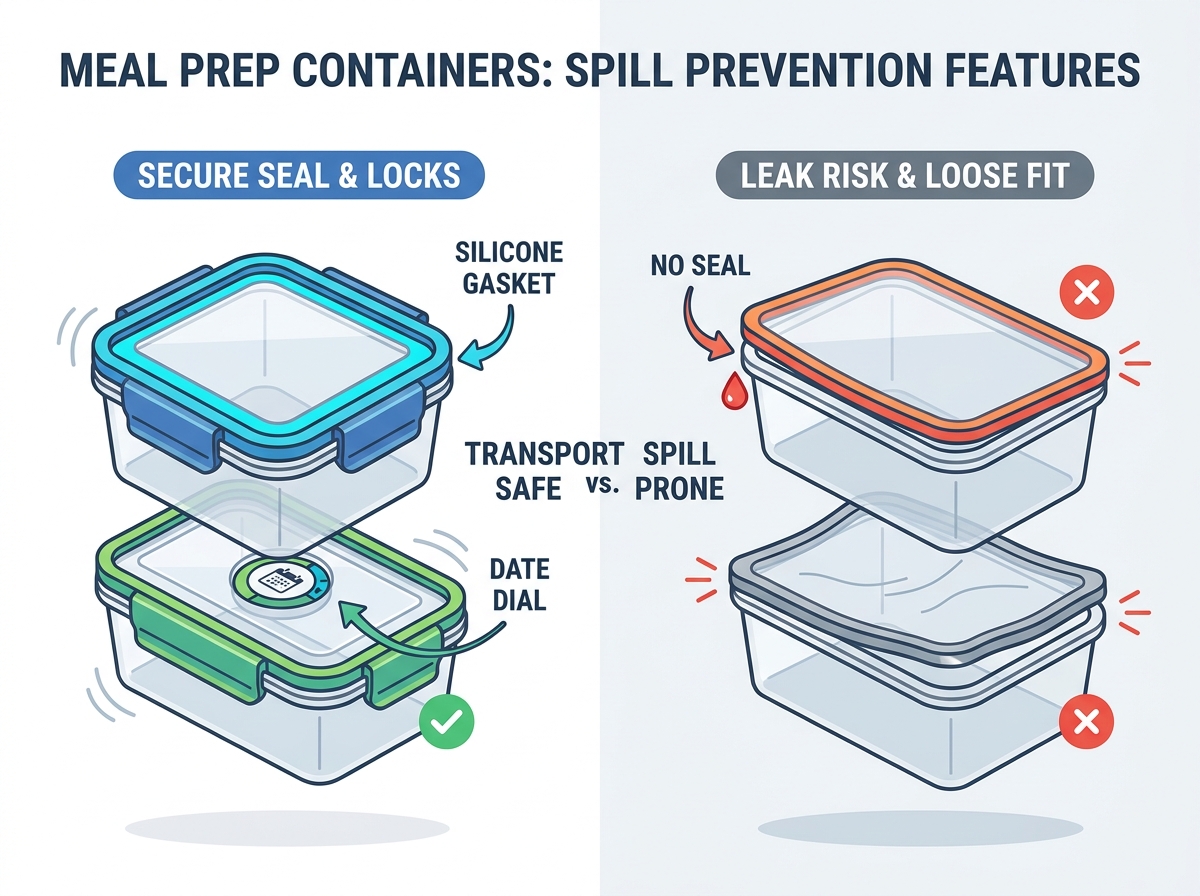
The four-hinge locking mechanism represents the gold standard for liquid transport. These lids feature mechanical tabs on all four sides that snap down over the container base. Inside the lid perimeter sits a continuous silicone gasket. When you engage the tabs, they pull the lid downward with significant force. This action compresses the silicone gasket against the rim of the base. The mechanical leverage provided by the hinges ensures the gasket remains under constant pressure.
Gasket compression fills microscopic gaps between the lid and base. Silicone is highly pliable and conforms exactly to the shape of the plastic rim. This creates a watertight, airtight barrier capable of resisting high hydrostatic pressure. Even if the container drops or experiences severe sloshing, the mechanical locks prevent the lid from separating from the base. The shore hardness of the silicone usually falls between 40 and 50A, providing the perfect balance of compressibility and tear resistance.
This security comes with a trade-off in cleaning complexity. Food particles and liquids can become trapped behind or underneath the silicone gasket. Proper sanitation requires removing the gasket periodically for deep cleaning. Failure to clean the gasket channel leads to mold growth and degrades the silicone material. Despite this maintenance requirement, snap-lock lids remain unmatched for spill prevention in dynamic environments.
Friction-fit designs dominate the takeout industry. These lids rely entirely on the tension created when a slightly smaller lid rim presses over a slightly larger base rim. The plastic-on-plastic seal requires exact manufacturing tolerances. If the plastic is too rigid, the lid cracks during application. If the plastic is too soft, the tension fails under minimal pressure. Manufacturers must dial in the exact interference fit to make these lids functional.
These lids have severe limitations for liquid transport. Plastic-on-plastic interfaces cannot fill microscopic imperfections. They lack the compressible nature of silicone. While suitable for semi-solid foods like rice or pasta, they fail quickly when transporting soups or thin sauces. The tension holding the lid in place degrades rapidly if the container experiences thermal expansion or vertical stacking stress. A minor bump can dislodge a friction-fit lid entirely.
To make friction-fit lids viable for semi-solid transport, manufacturers use recessed designs. A recessed lid sits inside the inner diameter of the base rim, while an outer lip snaps over the exterior. This creates a dual-contact sealing surface. It increases the physical distance liquid must travel to escape. It provides better lateral stability, but it still falls short of absolute leak-proof performance under extreme dynamic stress.
Threaded seals provide exceptional security for liquid-heavy meals. Soups, dressings, and broths require a seal that cannot pop off under pressure. Screw-on lids utilize a continuous helix thread. As you twist the lid, the threads pull the lid tight against the base. This mechanical advantage creates a highly secure closure that easily resists internal vapor pressure and external impacts. The rotational force translates into massive downward clamping pressure.
Many threaded lids also incorporate internal silicone gaskets or foam liners. The twisting action compresses these liners evenly across the entire rim. This uniform compression eliminates weak points in the seal. Threaded containers rarely fail during transport unless the user fails to tighten the lid completely or the threads become cross-threaded during application. They offer peace of mind for the most difficult liquid transport tasks.
The primary drawback is spatial inefficiency. Threaded lids require cylindrical containers. Cylinders do not pack efficiently into square or rectangular delivery bags. They leave significant dead space between units. This spatial inefficiency makes them less desirable for high-volume meal prep or commercial delivery, where maximizing bag capacity directly impacts profitability. You must balance the need for absolute spill prevention against spatial constraints.
Transporting hot food requires managing internal vapor pressure. Integrated steam release valves solve this problem directly. These small, resealable vents sit on the top of the lid. Before transporting hot food, you open the vent slightly. This allows expanding steam to escape the container without breaking the primary perimeter seal. It acts as a controlled exhaust port for the trapped thermal energy.
Pressure equalization prevents thermal pop-offs. By giving the steam a controlled exit point, the internal pressure matches the external atmospheric pressure. The main lid seal remains intact and secure. Once the food cools slightly and the initial steam dissipates, you press the vent closed to prevent liquid spills during the rest of the journey. This simple mechanical addition drastically reduces failure rates for hot food delivery.
High-quality valves use silicone plugs that create a secure seal when closed. Cheaper plastic flaps often warp and fail to seal properly after a few uses. When evaluating vented lids, inspect the mechanism of the valve itself. It must be easy to operate with one hand but secure enough to resist liquid pressure when fully seated. A loose vent plug defeats the purpose of a sealed container.
Hot food generates significant condensation. This moisture collects on the underside of the lid. In standard containers, this water runs down the lid and pools directly at the perimeter seal. This constant exposure to liquid weakens the seal and increases the risk of a breach during transport. Advanced lids incorporate internal moisture management systems to mitigate this risk before the water reaches the edge.
Condensation reservoirs are molded channels located just inside the primary seal. As water droplets form on the lid, they run down and collect in these internal catchment channels. The reservoir traps the condensation and minor liquid separation before it ever reaches the outer rim. This acts as an internal buffer against hydrostatic pressure. It keeps the actual sealing interface dry and secure.
By keeping the primary seal dry, the lid maintains maximum friction and tension. This feature proves especially valuable for transporting roasted vegetables or grilled meats, where excess moisture ruins the food texture and threatens the container seal. Internal reservoirs provide a passive but highly effective layer of spill defense without requiring any extra effort from the user.
Batch prepping requires accurate expiration tracking. Lids featuring integrated date-tracking dials allow users to mark the exact day food was stored. This eliminates guesswork and reduces food waste. However, adding moving parts to a lid introduces potential secondary leak points. Any penetration through the lid surface creates a vulnerability that liquids will eventually exploit under pressure.
Manufacturers mitigate this risk through isolated dial housings. The best date dial food containers mold the dial mechanism into a recessed cavity on the top of the lid. The plastic beneath the dial remains completely solid and unbroken. The dial rotates within its external housing without ever penetrating the internal food storage space. This engineering choice is non-negotiable for liquid transport.
This isolation ensures the primary perimeter gasket remains the only sealing surface to worry about. When evaluating date dial lids, check the underside of the lid. The surface should be smooth and continuous. If you can see the pins or gears of the dial from the inside, the lid is highly susceptible to leaking under pressure. Always prioritize solid internal surfaces.
Preventing cross-contamination between compartments is as critical as preventing external leaks. A container that keeps soup inside but allows it to flood the adjacent rice compartment is a failure. Standard flat lids cannot seal individual compartments. Liquid easily sloshes over the internal divider walls during transit, ruining the meal before it arrives at its destination.
Advanced compartmentalized lids feature molded internal ridges. These ridges mirror the exact layout of the base dividers. When you press the lid down, these internal ridges press flush against the top of the divider walls. This creates individual, isolated seals for every section of the container. Some premium designs even include silicone gaskets along these internal ridges for absolute separation.
This internal sealing requires extreme manufacturing precision. If the lid warps even slightly, the internal ridges will not align with the dividers. When selecting compartmentalized containers, prioritize rigid materials that resist bending. Test the internal seal by placing water in one compartment, sealing the lid, and aggressively shaking the container to check for internal breaches.
Material Properties and Deformation Risks
Material Type | Rigidity Level | Thermal Resistance | Primary Deformation Risk |
|---|---|---|---|
Polypropylene (PP) | Moderate / Flexible | Good (Microwave Safe) | Bowing under heavy vertical stacking pressure. |
Tritan Plastic | High / Very Rigid | Excellent (High Heat) | Cracking under extreme impact if dropped. |
Food-Grade Silicone | Highly Compressible | Exceptional | Degradation from harsh commercial detergents. |
The physical structure of the lid dictates its ability to hold a seal. Polypropylene (PP) is the most common material used in food storage. It offers excellent flexibility and fatigue resistance. This flexibility allows snap-lock hinges to bend repeatedly without breaking. However, PP can bow under heavy pressure. If a PP lid flexes too much during transport, the seal breaks and liquid escapes.
Tritan plastic provides a radically different structural profile. Tritan is highly rigid and mimics the clarity and stiffness of glass. A Tritan lid will not bow under stacking pressure or hydrostatic force. It maintains its exact geometric shape regardless of the load. This rigidity ensures the silicone gasket receives uniform compression at all times, eliminating weak points along the perimeter.
The choice between PP and Tritan depends on the specific stress factors of your transport method. PP absorbs impacts better without shattering, making it suitable for rough handling. Tritan excels at resisting deformation under pressure, making it ideal for deep liquid transport where seal integrity is paramount. Understanding these polymer characteristics guides better purchasing decisions for your specific needs.
Thermal degradation causes delayed seal failure. A container might perform perfectly for a month and then suddenly begin leaking. This usually results from heat warping. Microwaves create uneven heat distribution, creating hot spots that soften the plastic. Dishwashers subject lids to prolonged high heat and aggressive water pressure during the drying cycle, which can exceed 150 degrees Fahrenheit.
Repeated thermal cycling alters the molecular structure of the plastic. The lid subtly changes shape. It may lose its perfectly flat profile or the rim dimensions may shrink slightly. Once a lid warps, it can no longer apply even pressure to the base rim. The spill-prevention capabilities are permanently degraded. You cannot fix a warped lid; it must be discarded.
Evaluating heat-resistance ratings prevents this issue. Look for lids specifically engineered for high-temperature commercial dishwashers. Thicker plastic profiles resist warping better than thin, single-use designs. If you rely on snap-lock lids, always wash them on the top rack of the dishwasher to minimize direct exposure to the heating element at the bottom of the tub.
Freezing temperatures introduce a different set of material failures. When plastics freeze, their polymer chains contract. The material loses its flexibility and becomes highly brittle. A lid that easily snaps onto a base at room temperature may crack instantly if applied straight out of the freezer. The mechanical stress of snapping a frozen hinge often causes catastrophic failure.
Cold brittleness severely impacts transport. If a frozen container bumps against another object in a cooler, the brittle plastic can develop micro-cracks. These cracks often occur at the hinge points of snap-lock lids or along the tension rim of friction-fit lids. Once a micro-crack forms, the lid loses its structural integrity and will leak as the food thaws during transit.
Freezing affects silicone gaskets as well. Cold silicone hardens and loses its compressibility. If you transport a frozen container, the hardened gasket may not seat properly against the base rim. Always allow frozen containers to rest at room temperature for a few minutes before subjecting them to heavy transport stress to allow the materials to regain their flexibility.
Spill prevention relies heavily on the chemical stability of the sealing materials. Selecting containers with FDA-approved, food-grade silicone gaskets is mandatory. Food-grade silicone resists chemical breakdown when exposed to acidic foods like tomato sauce or citrus dressings. Non-compliant materials degrade rapidly under these conditions, turning a secure seal into a leaking mess.
Degradation manifests as hardening, shrinking, or becoming sticky. Once a gasket degrades, it loses its ability to compress and fill the microscopic gaps between the lid and base. The spill-prevention barrier fails entirely. Commercial kitchens must be particularly vigilant, as industrial sanitizers accelerate the breakdown of cheap rubber or low-grade silicone seals.
Regular inspection of the gasket channel is required. Pinch the silicone between your fingers; it should feel highly elastic and spring back instantly. If it feels stiff or remains compressed, the gasket has failed. Investing in compliant, high-quality materials upfront prevents catastrophic leaks and ensures long-term operational safety for both personal and commercial applications.
The financial realities of food transport dictate lid selection. Personal meal prep allows for higher initial investments. Spending more on heavy-duty, snap-lock lids with silicone gaskets makes financial sense because the user washes and reuses the container hundreds of times. The cost per use drops to fractions of a cent, justifying the premium spill-prevention features required for daily commuting.
Commercial operations face a different equation. High-volume takeout requires thousands of containers weekly. Investing in heavy-duty gasket lids for single-use delivery destroys profit margins. Commercial operators must find high-tolerance, friction-fit lids that balance acceptable spill prevention with low unit costs. The financial trade-off forces commercial kitchens to rely on design geometry rather than expensive mechanical gaskets.
This divergence means consumer-grade solutions rarely scale to commercial environments. A commercial operator must evaluate the failure rate of cheaper lids against the cost of replacing ruined orders. Finding the exact price point where lid tension prevents spills without requiring mechanical locks is the core challenge of commercial packaging procurement.
Delivery drivers carry multiple orders simultaneously. Stacking stability directly impacts spill rates. If containers slide laterally during a sharp turn, the stack collapses. The resulting impact pops lids off and ruins the food. Flat lids offer zero lateral support and are highly dangerous in commercial transport environments where sudden vehicle movements are guaranteed.
Effective takeout food storage containers feature interlocking base-to-lid grooves. The top of the lid contains a recessed channel that exactly matches the footprint of the container base. When stacked, the base of the upper container locks into the lid of the lower container. This physical interlock prevents lateral sliding entirely, keeping the stack rigid.
Preventing tip-overs reduces dynamic impact stress on the lid seals. Interlocking features allow delivery personnel to stack orders higher with confidence. When evaluating commercial containers, physically stack three units and tilt them to 30 degrees. If the top unit slides off, the lid design is insufficient for high-volume delivery operations.
Operational friction matters in commercial environments. During a dinner rush, line cooks must seal hundreds of containers rapidly. Complex lid mechanisms slow down the line. Snap-lock lids with four individual hinges require too much time and manual dexterity to apply efficiently in a fast-paced kitchen. Every second spent fiddling with a lid delays the order.
Commercial kitchens reject slow packaging. They prioritize high-quality friction lids that apply with a single, swift downward motion. An audible-click feature is highly desirable. When the cook presses the lid, a loud snap confirms the perimeter seal is fully engaged. This tactile and auditory feedback ensures proper application without slowing down service.
The lid must also separate easily from the master stack. Lids that stick together in the packaging sleeve cause frustration and slow down plating. Evaluating commercial lids requires testing how fast a cook can grab a single lid, apply it to the base, and verify the seal under pressure without looking.
No lid is infallible under extreme transit conditions. A car accident, a dropped bag, or severe mishandling will breach even the best mechanical seals. Relying entirely on the primary container lid is a flawed strategy for commercial delivery. You must implement secondary containment solutions to protect against catastrophic failure and protect the rest of the delivery batch.
Waterproof-lined insulated delivery bags form the first layer of backup defense. If a container leaks, the liquid must remain trapped inside the bag, protecting the driver's vehicle and preventing cross-contamination with other orders. Bags with welded seams perform significantly better than stitched bags, which allow hot liquids to seep through the thread holes.
Strategically placed absorbent liners provide the final layer of protection. Placing a highly absorbent pad at the bottom of the delivery bag catches minor leaks before they pool and damage paper bags or cardboard outer packaging. Pairing high-quality lids with robust secondary containment ensures that even if a seal fails, the customer experience and operational logistics remain protected.
Spill prevention is a strict mechanical equation. Achieving a leak-proof seal requires the correct combination of gasket compression, material rigidity, internal pressure management, and secondary containment planning. Friction-fit lids fail under dynamic sloshing and thermal expansion, while engineered mechanical locks and pressure vents actively resist these transport stresses. Ignoring the physics of fluid dynamics during transit guarantees eventual container failure and the associated costs of ruined food and damaged property.
Categorize your specific needs to select the right lid technology. For personal, liquid-heavy meal prep, prioritize silicone-gasket snap-lids that offer maximum hydrostatic resistance. For commercial hot food delivery, select vented friction-fit lids with interlocking stacking grooves, and always pair them with secondary containment bags. If long-term batch prepping is your goal, invest in date-dial lids with isolated housings to track freshness without compromising the primary seal.
Take immediate action to secure your food transport:
Audit your current container inventory and discard any lids showing signs of thermal warping, edge curling, or stiff gaskets.
Request sample units of commercial containers and physically test their interlocking stacking stability at a 30-degree angle.
Fill your selected containers with hot water, seal them, and perform a dynamic slosh test to check for vapor pressure pop-offs.
Implement waterproof delivery bags with welded seams as a mandatory secondary containment protocol for all commercial transport.
A: A truly leak-proof container requires a compressible silicone gasket combined with a mechanical locking mechanism. The locks pull the lid down, compressing the silicone to fill microscopic gaps between the lid and base. This physical barrier withstands high hydrostatic pressure and sloshing during dynamic transport.
A: Hot food heats the trapped air and releases steam, creating significant internal vapor pressure. This pressure pushes outward against the lid. Without steam release vents to equalize the pressure, the force eventually overcomes the mechanical grip of the lid, causing it to pop off.
A: Yes. Snap-lock lids use mechanical hinges to physically anchor the lid to the base, maintaining a seal even under heavy vibration. Friction-fit lids rely solely on plastic-on-plastic tension, which easily breaks when exposed to liquid sloshing, vertical stacking stress, or thermal expansion.
A: High-quality date dial containers isolate the tracking mechanism from the primary seal. The dial sits inside a recessed external housing on the top of the lid. Because the plastic beneath the dial remains solid and unbroken, it does not create a secondary leak point.
A: Yes. Repeated exposure to high heat in a dishwasher causes thermal warping. The plastic degrades and loses its original geometric shape. Once a lid warps, it cannot apply even pressure to the base rim, and silicone gaskets may harden, permanently ruining the spill-prevention barrier.
A: The best commercial lids feature interlocking stacking grooves to prevent lateral sliding, audible-click secure perimeters for fast and verified application, and internal condensation channels to trap moisture before it weakens the primary tension seal.


