
English 

Views: 0 Author: Site Editor Publish Time: 2026-08-14 Origin: Site


The structural mismatch between heavy-duty stainless steel bases and fragile glass lids creates a unique storage challenge for high-volume kitchens and meal-prep systems. While glass lids provide clear visibility and non-reactive properties for storing acidic foods, they introduce a fragility factor to otherwise indestructible metal bases. Improper stacking leads to uneven compressive stress. This results in shattered tempered glass, compromised silicone gaskets, and inefficient use of pantry or commercial walk-in space. Establishing a standardized stacking protocol protects your equipment and streamlines daily operations. This guide breaks down the physics of load distribution, evaluation criteria for stackable designs, and risk-mitigation strategies for organizing mixed-material food storage systems. By implementing these practices, you maximize vertical space without sacrificing the integrity of your Stainless Steel Containers with Glass Lids.
Weight Distribution is Critical: Never stack heavy bases directly on unsupported glass centers; load-bearing must occur at the reinforced rim or via interlocking silicone bumpers.
Nesting vs. Stacking: True spatial efficiency requires separating bases for nesting while vertically filing glass lids, rather than stacking fully assembled units.
Seal Integrity: Stacking fully sealed vacuum stainless containers can warp the rubber gaskets over time due to trapped pressure and external weight.
Commercial Viability: For restaurant food storage containers, standardized sizing and nonslip lid perimeters are non-negotiable features to prevent lateral sliding and breakage.
Defining a safe stack requires looking at three primary success criteria. First, you need zero lateral movement. Containers must not slide off one another when the shelf is bumped or a nearby item is moved. When you load a wire shelving unit in a walk-in cooler, the metal racks flex slightly under heavy loads. If your containers lack positive interlocking features, this minor shelf deflection causes the top units to slide. A safe stack requires absolute lateral stability. You must be able to bump the shelf with a utility cart without sending a cascade of metal and glass onto the quarry tile floor.
Second, you must achieve zero pressure on the glass center. Tempered glass handles broad impacts well but fails under concentrated point-loads. Third, the stack must remain accessible. You should not have to unstack an entire column just to retrieve a single unit from the middle. If your current storage method fails any of these criteria, your inventory is at risk of damage and your kitchen is operating inefficiently.
Random or uneven stacking exerts concentrated point-loads on tempered glass. When you place a heavy metal base directly onto a smooth glass surface, the weight does not distribute evenly. Instead, it focuses on the lowest points of contact. Microscopic variations in the metal mean the entire weight of the upper container rests on two or three tiny contact points. If that upper container holds ten pounds of liquid, you are applying massive pounds per square inch to a fraction of a millimeter of glass. Over weeks of repeated stacking, this localized stress creates micro-fissures. Eventually, the glass shatters spontaneously.
You must also understand the difference between static load and dynamic load. A static load occurs when containers sit perfectly still on a shelf. A dynamic load occurs when you move a stack across a kitchen or transport it in a catering vehicle. Dynamic loads multiply the force exerted on the glass. Rolling a loaded speed rack across the grout lines of a tiled floor sends severe vibrations up the vertical columns. A stack that seems stable on a pantry shelf can easily shatter when subjected to the vibrations of a moving cart. Always design your stacking protocols around dynamic load tolerances.
High-grade silicone or rubber gaskets act as essential shock absorbers. They sit between the rigid metal base and the fragile glass lid, dampening impacts and distributing weight. However, gaskets are designed to create an airtight seal, not to bear heavy structural loads. Stacking heavy containers on top of sealed lids can permanently flatten the airtight seal.
When you apply sustained vertical weight to a silicone gasket, the material compresses. If left in this compressed state for days or weeks, the silicone loses its elasticity. It suffers from compression set, meaning it will no longer rebound to its original shape. Once the gasket flattens, the container loses its leak-proof properties. You must ensure that vertical weight transfers through the outer structural rim of the lid, rather than pressing directly down onto the sealing gasket. Kitchen operators often mistake a leaking container for a manufacturing defect, when in reality, improper stacking destroyed the gasket's memory.
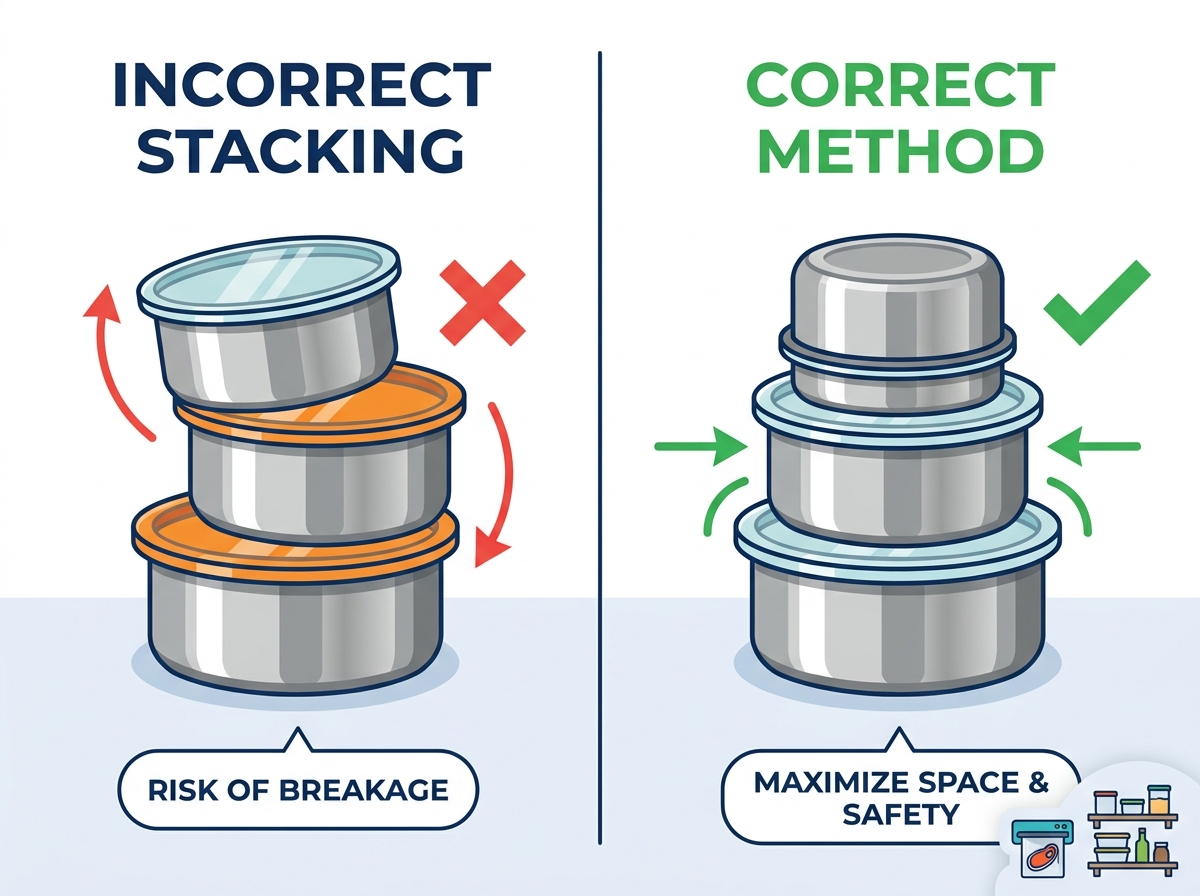
The safest containers feature lids with recessed glass and raised silicone or plastic rims. This design locks the bottom of the next container securely in place. The raised rim acts as a physical barrier, preventing the metal base above from sliding off center. It also ensures that the weight of the upper container rests entirely on the durable outer rim, suspending the base slightly above the fragile glass center. This mechanical interlock is the only way to safely stack assembled units.
Nonslip lid perimeters are an absolute necessity. Smooth glass lids without rubberized edges fail in vertical storage. Without friction to hold the upper container in place, minor vibrations cause lateral shifts. A slight bump to the storage rack will send the top containers crashing to the floor. Always prioritize lids that incorporate a high-friction material along the outer edge. If your current lids are entirely smooth glass, you cannot safely stack them while assembled.
Graduated sets naturally nest like Russian dolls. They offer maximum space savings for varied storage needs. Because each base is slightly smaller than the one before it, they sit deeply inside one another without wedging. This is ideal for kitchens that handle a wide variety of ingredient volumes, allowing you to store ten containers in the footprint of one.
Same-size sets are essential for uniform meal prep and portion control. However, they require highly tapered stainless steel bases to nest deeply. If the walls are too straight, the bases will wedge together and become permanently stuck. Straight-walled containers offer better space efficiency for the food inside, but they are nearly impossible to nest. This forces you to vertically stack fully assembled units, which consumes massive amounts of shelf space.
Container Nesting Profile Analysis
Profile Type | Space Efficiency | Jamming Risk | Best Application |
|---|---|---|---|
Graduated Sets | Maximum | Low | Mixed ingredient storage |
Same-Size Tapered | High | Moderate | Uniform meal prep |
Same-Size Straight Wall | Low | High | Single-layer shelf storage |
Vacuum valves on the lid significantly impact stackability. When dealing with vacuum stainless containers, you must protect the valve mechanism from the weight of the container above it. If a heavy metal base presses directly onto a delicate silicone vacuum valve, it can break the seal or permanently damage the air-release mechanism.
To safely stack these units, ensure the valve is recessed below the lid's outer rim. The interlocking mechanism of the lid must hold the upper container high enough to clear the valve completely. If the valve protrudes above the highest point of the lid, you cannot safely stack fully assembled units. You must separate the components for storage to prevent destroying the vacuum functionality.
Transitioning from haphazard home storage to standardized commercial protocols requires discipline. In a high-volume kitchen, you cannot afford to waste time searching for matching lids. You must implement the "Lid Magazine" approach. This involves storing stainless bases nested in tall vertical columns and filing glass lids horizontally in a dedicated rack.
When organizing restaurant food storage containers, dedicate specific shelving zones for different sizes. Keep the nested bases directly adjacent to their corresponding lid magazine. This system allows staff to grab a base with one hand and a lid with the other in a single fluid motion. It completely eliminates the risk of glass breakage caused by precarious vertical stacks of assembled containers. You can build a lid magazine using standard slotted dish racks or heavy-duty wire file organizers bolted to your shelving units.
The impact of thermal expansion and contraction on stacked containers is severe. Stainless steel and glass expand and contract at different rates when exposed to extreme temperature changes. When you move a stack of containers from a walk-in freezer to a warm prep area, these materials shift. The metal base shrinks slightly in the cold, while the glass remains relatively stable, altering the fit of the interlocking mechanisms.
Stacking frozen stainless containers with glass lids requires extra care. Freezing temperatures increase glass brittleness and make silicone seals rigid. A rigid gasket loses its shock-absorbing properties. If a stack shifts while frozen, the impact transfers directly into the brittle glass, causing immediate shattering. Never stack frozen containers more than two units high. Handle them gently until the materials return to room temperature, allowing the silicone to regain its flexibility before applying any heavy dynamic loads.
The primary cause of micro-abrasions is metal bases sliding against glass lids during stacking and unstacking. Stainless steel is significantly harder than tempered glass. Dragging a steel base across a glass surface creates microscopic scratches. Over time, these scratches compromise the structural integrity of the glass, making it prone to sudden failure under thermal or physical shock. A lid that looks perfectly fine can shatter when exposed to hot water if it has accumulated enough micro-abrasions.
To mitigate this risk, utilize containers with protective silicone boots on the base. If boots are not an option, you must mandate a strict lift-don't-slide operational rule for all kitchen staff. When removing a container from a stack, staff must lift it straight up until it clears the lid below. Dragging the container horizontally is strictly prohibited. Training your dish pit and prep staff on this single motion will drastically extend the lifespan of your glass lids.
Stacking wet stainless steel bases inside one another creates an unintended seal known as a vacuum lock. When containers come out of the dish pit, they are hot and wet. If your staff immediately nests them, the trapped water evaporates slightly as the metal cools. This pulls a vacuum between the tightly nested metal walls. The containers become fused together, severely slowing down prep operations and risking injury as staff struggle to pry them apart.
Mitigate this by enforcing complete drying protocols before nesting. Containers must pass through a high-heat drying cycle or be thoroughly hand-dried. Additionally, utilize bases with internal nesting ridges. These small indentations prevent the walls from making full contact, allowing air to flow between the nested units and preventing vapor lock entirely. If a vacuum lock does occur, submerge the bottom container in hot water and fill the top container with ice water to break the seal.
Mixing brands or generations of containers leads to highly unstable stacks. A lid designed for one specific taper will not properly support a base from a different manufacturer. The interlocking mechanisms will fail to align, causing the stack to lean and eventually collapse. Even a millimeter of difference in the rim diameter can turn a secure stack into a hazard.
Standardize your procurement to a single modular system. Ensure uniform footprint dimensions across your entire inventory. If you must upgrade your containers, phase out the old inventory completely rather than mixing it with the new. Uniformity is the foundation of safe and efficient vertical storage. Do not allow staff to force a mismatched lid onto a base, as this warps the silicone gasket and guarantees a leak.
Common Stacking Failures and Solutions
Failure Mode | Root Cause | Operational Fix |
|---|---|---|
Glass Shattering | Point-loads on glass center | Use lids with raised load-bearing rims |
Vacuum Lock | Nesting wet metal bases | Implement strict dry-before-nesting rules |
Gasket Flattening | Heavy vertical weight on seals | Separate components for long-term storage |
Lateral Sliding | Smooth glass perimeters | Upgrade to lids with nonslip silicone edges |
Storing empty containers fully assembled offers immediate readiness for rapid meal prep. It prevents the frustration of hunting for lost lids and protects the clean interior from airborne dust and debris. For low-volume operations or residential kitchens, this method simplifies inventory tracking and ensures that every base always has its matching lid ready to go.
However, the cons are significant in a commercial setting. Assembled stacking is highly inefficient, wasting massive amounts of vertical space. It also places maximum weight strain on the glass lids if stacked while full. You are limited to very short stacks, usually no more than three units high, before the risk of tipping or glass failure becomes unacceptable. You also risk compressing the silicone gaskets if the latches are engaged during long-term empty storage.
Separating the components maximizes spatial efficiency. You can fit dozens of nested metal bases into the same vertical footprint that would only hold three assembled units. This approach completely eliminates compressive stress on the glass, as the lids are filed safely in a rack. It preserves the elasticity of your gaskets and protects the glass from accidental point-loads.
The downside is that it requires secondary organizational tools, such as lid organizers or slotted drying racks. It also slightly increases prep time, as staff must match components before filling. Despite these minor drawbacks, component separation remains the superior method for high-volume environments. The space saved and the reduction in broken equipment far outweigh the cost of installing a lid magazine.
Operational Storage Method Evaluation
Configuration | Vertical Footprint | Glass Protection Level | Retrieval Speed |
|---|---|---|---|
Fully Assembled | Massive | Poor | Fast |
Nested Components | Minimal | Excellent | Moderate |
Loosely Clipped | Massive | Moderate | Fast |
Audit your current storage area and immediately disassemble any precarious vertical stacks of assembled containers exceeding three units.
Inspect all glass lids for micro-scratches, edge chips, or flattened silicone gaskets, discarding any compromised units to prevent in-service shattering.
Install a dedicated lid-filing rack to securely separate your metal bases from the fragile glass tops.
Implement a strict dry-before-nesting operational rule to prevent vacuum locks between stainless steel bases.
A: Yes, but avoid stacking them more than two high. Freezing makes silicone gaskets rigid and glass more brittle, increasing the risk of cracking if the stack shifts or if heavy weight is applied to the center of the glass.
A: To prevent scratches, ensure the bottom of the stainless steel container rests on the silicone or plastic rim of the lid below it, not directly on the glass. Alternatively, place a paper towel or felt separator between assembled containers.
A: It depends on the valve design. If the vacuum valve protrudes above the rim of the lid, stacking another container on top can damage the valve or break the vacuum seal. Look for designs with recessed valves.
A: In high-volume settings, separate the components. Nest the stainless steel bases together to save shelf space, and store the glass lids vertically in a slotted drying rack or dedicated lid organizer to prevent breakage.
A: While storing empty containers fully assembled prevents lost lids and saves time during meal prep, nesting the bases and filing the lids separately is significantly better for maximizing cabinet space.
A: Moisture trapped between tightly nested stainless bases creates a vacuum lock, especially in same-size sets without a deep taper. Always ensure containers are 100% dry before nesting, or purchase bases with anti-jamming ridges designed to allow airflow.


